Overview
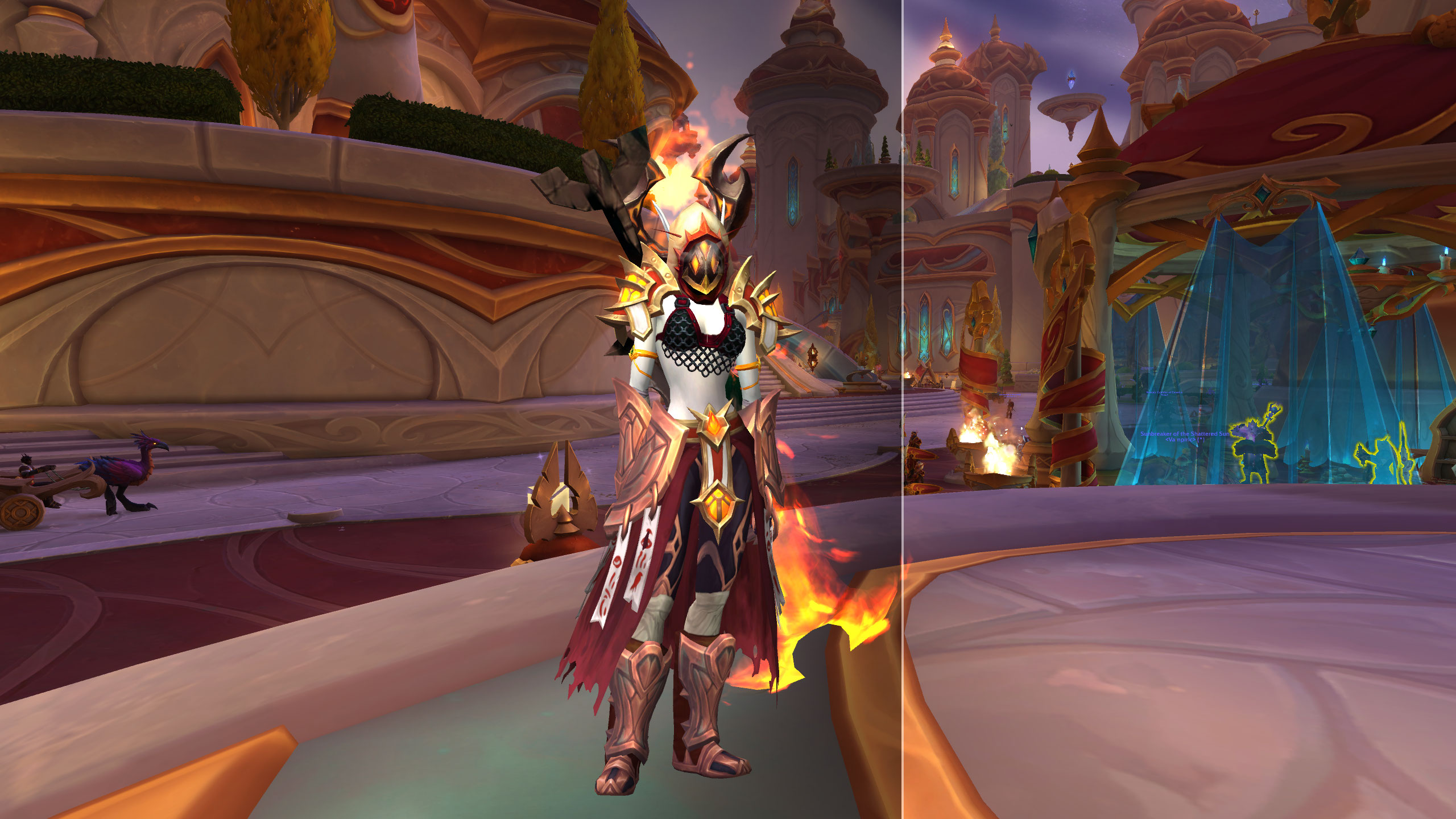
Lothírnaethwen Dawnscorn — Lady Lothwyn, to anyone who knew her before — is a Sin'dorei Death Knight of House Dawnscorn, and one of the few people to have died twice in service of Quel'Thalas and kept fighting afterward. She carries herself with the composure of a woman in complete control: aristocratic bearing, precise movement, the contained stillness of someone who has transformed grief into discipline and discipline into something very close to a weapon.
She is not in complete control. She is brilliantly intelligent, and she uses that intelligence to hide, with considerable skill, how fractured she actually is.
The hunger is always there. Death Knights learn to manage it, to give it direction, to keep the gnawing need for suffering pointed outward and purposeful. For a time, Sylvanas Windrunner gave it purpose. When the Dark Lady left, she took that purpose with her, and Lothwyn has been reconstructing the architecture of her own sanity ever since — carefully, logically, with the precision of someone who knows exactly how close she is to coming apart.
Very few people know she exists. Her twin sister Aereth intends to keep it that way.
Appearance
She is imposingly tall for a Sin'dorei, with an exceptionally muscular, athletic build that reads as incongruous against the aristocratic sharpness of her features — broad shoulders, powerful arms, the kind of strength that comes from decades of genuine use rather than any decorative purpose. She moves with absolute deliberation: every step controlled, every gesture economical, the coiled readiness of something permanently prepared to become violent.
Her blood-red hair is cut short and sharp — a wolf cut, layered and choppy, with straight bangs that frame a face of cold angular precision. High cheekbones, a defined jawline, an expression of focused calm that rarely shifts. Her eyes are the luminous blue of a Death Knight's raising: intense, calculating, resting on things with the measuring patience of someone who has learned to treat every situation as a tactical problem.
Her skin is pale and undead-cold, mapped with battle scars across her arms, her torso, her hands — the record of conflicts survived and, given her nature, not always survived cleanly. She wears dark necromantic armor in deep crimson or necrotic green, runic engravings running along the plates. Her midriff is often exposed, a deliberate choice, the scarred abdomen another piece of the same message her bearing delivers: she knows exactly what she is, and she has stopped being concerned about your reaction to it.
The overall impression is of someone who has compressed themselves into something between elegant noble and perfected instrument of war. Dangerous competence, aristocratic precision, the barely-visible tension of a weapon that has learned patience.
Personality
There is a version of Lothwyn that most people encounter: controlled, composed, precise. She speaks with the measured confidence of someone accustomed to being listened to. She does not raise her voice. She assesses problems with the cool efficiency of a veteran tactician, arrives at solutions before others have finished articulating the question, and delivers her conclusions without sentiment or ceremony. Her intelligence is evident and almost unsettling in its precision. She manages the social architecture of interactions the way she manages a battlefield — by staying three steps ahead.
This version of Lothwyn is real. It is also armor.
The person underneath it died twice and came back wrong both times, and the elf who had once been the boisterous, laughing life of every gathering — quick to smile, quicker with a blade, the one who threw herself at the training grounds with infectious joy — is gone with such thoroughness that most who meet her now could not imagine she ever existed. What remains of her childhood self lives in the twin bond with Aereth, in flashes of dark humor delivered so deadpan they are nearly imperceptible, and in a ferocity of loyalty that, deprived of its object, has nowhere left to go.
The Death Knight hunger is a constant presence. She has given it direction before — under the Dark Lady's command, the need for violence had purpose, the necromancy served something, the hunger was pointed outward at enemies and given meaning. Without that, she manages. She finds direction where she can. She keeps the architecture standing through will and intelligence alone, and she is aware of exactly how much effort that requires, which is information she shares with almost no one.
Aereth knows. Aereth has always known — she found Lothwyn at her worst, saw the hunger in full, and made a quiet, deliberate decision to keep that knowledge to herself. Lothwyn is not entirely comfortable with being known so completely by anyone, including her twin. She has decided not to examine how much of a relief it actually is.
She has built a private narrative to keep herself functional: Sylvanas was used, not broken. Corrupted by forces beyond even her power. The Dark Lady did not betray the Horde; she was weaponized against it. And she will return — redeemed, freed, herself again — and Lothwyn will be ready. This belief is logical and precise and she has constructed it so carefully that she can feel it holding. She knows she cannot say it aloud. She knows how it would sound. She keeps it locked behind composure and functions.
She is, underneath it all, completely right that she is barely holding together. She is also correct that most people will never know.
Backstory
House Dawnscorn
The Dawnscorn name was old blood — High Elven aristocracy with deep roots in Quel'Thalas, generations of carefully cultivated standing in Silvermoon's courts, the kind of house whose founding had become more mythology than record even to its own members. Lothírnaethwen and her twin sister Aevynareth were born into that legacy, raised with the expectation of continuing it.
They were different children. Aereth was reserved and contemplative, drawn to scholarship and the quieter levers of influence. Lothwyn was the opposite: loud, enthusiastic, the life of every gathering and the first one onto the training grounds in the morning. Where her sister navigated courtly functions, Lothwyn excelled in military strategy and martial training with an infectious joy she didn't yet know was temporary. They were often apart. They never felt it.
Their parents were assassinated shortly before the Scourge invasion — political intrigue, old rivalries, shadows in Silvermoon's gleaming spires. The twins became acting heads of House Dawnscorn almost overnight, still reeling, with no time to grieve or investigate or seek justice.
Because then Arthas came.
The Fall
Both sisters answered the call to defend Quel'Thalas. Lothwyn's military training finally had its purpose; she fought with everything she had, inspired by Sylvanas Windrunner, determined that House Dawnscorn would make its stand.
She was on a different section of the front when the city fell. She heard the horns. She saw the smoke. She learned, afterward, that Sylvanas had been taken — raised by Arthas as his banshee, a deliberate performance of dominance. And somewhere in that same chaos, Aereth had died too. Another elf cut down, another body in the carnage. Gone, as far as Lothwyn knew.
When it was over, she believed herself the last Dawnscorn standing. The family that had endured for generations — shattered in a matter of weeks. Their parents' killers would never be identified. The investigation died with everything else.
The boisterous, laughing warrior who'd loved the training grounds was gone. The person who emerged from the fall of Quel'Thalas was grimmer, quieter, and harder, and stayed that way. While the Horde moved on — to Outland, to other wars, to other crises — Lothwyn remained in Silvermoon. She couldn't leave. Someone had to stand watch.
The Second Death
When the Scourge descended again on a vineyard in Eversong Woods, Lothwyn was among the first to answer. She held the line long after others had retreated, rallied defenders, refused to yield another inch. She was among the last to fall.
The Scourge did not leave her body in Eversong's soil. Her tenacity, her skill, her refusal to break — these made her valuable. She was taken north to Icecrown. She was not raised as a mindless soldier. She was remade: a Death Knight, one of Arthas's chosen champions, consciousness trapped in an undead shell and forced to serve the monster who had taken everything from her.
She rose again. Just as Sylvanas had. When the Lich King's control finally broke and she claimed her freedom, she carried with her what all Death Knights carry: the endless, gnawing hunger to inflict suffering on the living.
Redridge
She retreated from public life. She spent a year in the Redridge Mountains, sating the hunger on Alliance soldiers, bandits, travelers — anyone who crossed her path. She told herself it was for the Horde, that it was justified, that Alliance blood was always justly spilled.
The truth was that she was losing herself. Day by day, kill by kill, the line between controlled Sin'dorei aristocrat and mindless butcher blurred. The hunger grew stronger, not weaker. She was becoming what Arthas had intended — a weapon without direction, violence without purpose.
Salvation came from someone she had believed dead for years.
She was sitting alone in the ruins of a tower in Redridge, iron-cold and barely herself, and she heard her own voice reciting a line from a nursery rhyme she and her sister had loved as children. She heard it because Aereth was finishing the verse — standing in the doorway, Darkfallen and entirely herself, having followed whispers of a rogue Death Knight across the mountains until she found what she already knew she would find.
When Lothwyn turned, she saw a silhouette in the sun. She saw nothing she recognised. And then she did.
Aereth looked at her for a long moment — at all of it, the hunger, the wreckage, the thing Lothwyn had been becoming — and said, with the particular unhurried calm that has always been her way: "Come home. I have been holding the House together long enough for both of us."
She did not pretend the situation was manageable. She did not offer false comfort. She simply made it clear, in the way she makes most things clear, that the matter was already decided.
Service to Sylvanas
The Dark Lady herself offered purpose in place of madness. Sylvanas Windrunner — who understood, because she had walked the same dark road — welcomed both sisters into service. The hunger finally had direction. Lothwyn's violence finally meant something.
She became one of Sylvanas's chosen shock troopers through the Fourth War — sent when a problem required overwhelming force, absolute loyalty, and no questions asked. She stood at the Burning of Teldrassil. She fought at the Siege of Lordaeron. She sailed to Zuldazar and followed orders directly from the Warchief herself, the only way she knew how: completely.
She loathed Nathanos Blightcaller. She kept that buried.
It was during this period she met Mal'koreth Cinderstorm — an Orc shaman and saboteur assigned to destroy an Alliance fortification in Tiragarde Sound. Her role was to ensure he survived if things went wrong. Things went wrong. She held the line while he worked, and they fought their way clear together. He was pragmatic, honest about what destruction served, and refused to dress violence up as anything noble. She found his bluntness almost refreshing, and trusted him in the way she trusted very few people — because he earned it.
The Breaking
She was on the wall at the Mak'gora. She watched Saurfang challenge the Warchief with the quiet confidence of someone who knew how it would end. She even smirked at his opening moves.
Then:
"The Horde is NOTHING. You are all NOTHING."
She felt water on her cheeks. The sun was shining. Her grip on her sword — normally iron — felt weak. And as she watched Sylvanas rise and fly and disappear, Lothwyn collapsed. She would not be the same again.
Aereth met with Sylvanas privately afterward, at Windrunner Spire in the Ghostlands. Lothwyn had been invited. Aereth didn't tell her. She knew her twin well enough to know that some information was more dangerous than protective — and she knew exactly how the hunger responds to a fracture in the architecture that keeps it pointed outward.
These days, Lothwyn functions. She is brilliantly intelligent, and that intelligence is the entire reason she does. She has constructed a framework: Sylvanas was corrupted, not broken. Used, not treacherous. She will return. When she does, Lothwyn will be ready. This belief is logical and precise and it keeps the architecture standing and she cannot speak a word of it to anyone.
She has joined the Fist of Hammerfall, because Mal'koreth asked and she trusted his judgment. She serves. She waits. The hunger gnaws at her, louder than ever.
The Secret
Lothwyn's return is not public knowledge. Aereth has ensured this with the same quiet efficiency she applies to everything else that cannot be permitted to become a problem.
A Death Knight who served at the Burning of Teldrassil, who followed Sylvanas directly, who disappeared in the chaos of the Mak'gora — these are not credentials that survive scrutiny in the current Horde. Aereth understands this. She also understands her sister: that the hunger is real, that the fractures are real, that Lothwyn's grip on herself is strong but not unlimited. The fewer people who know she exists, the fewer variables that might introduce pressure she cannot predict.
Aereth is not being protective in the way that patronizes. She is being precise in the way that keeps people alive. Lothwyn knows the calculus. She accepts it, which is itself a sign of how much she trusts her twin — and how aware she is of her own fragility.
Relationships
| Character | Relationship | Notes |
|---|---|---|
| Aereth | Twin sister — Darkfallen warlock | Two responses to the same tragedy. Aereth is complete unto herself; Lothwyn is not. The bond is the one constant that has survived every version of her — and the one person who has seen the hunger in full and stayed anyway. |
| Mal'koreth Cinderstorm | Trusted ally | Orc shaman, saboteur, the reason she joined the Fist of Hammerfall. Pragmatic and honest in ways she respects. One of very few people she trusts. |
| Sylvanas Windrunner | Former Warchief — complicated | Her purpose and her breaking point. The loyalty is intact, internalized, and unspoken. She keeps it locked behind composure and waits. |
Notes
RP hooks:
- She presents as controlled, precise, aristocratic. She is. She's also barely holding together — and sufficiently intelligent to hide how completely. Given enough time and the right pressure, the cracks become visible.
- The internal Sylvanas narrative: she believes it completely and cannot speak it to anyone. Discovering this — and what you do with that information — could go many directions.
- The hunger is always present. She manages it. On a bad day, the management is visible.
- Her parents were assassinated and she never found out by whom. That thread is still there, loose, after everything else that has happened.
- The twin bond with Aereth is genuine and old and the one relationship she doesn't hold at arm's length. Characters connected to Aereth, or situations that put Aereth at risk, will reveal a different Lothwyn.
- Very few people know she's alive. You are presumably one of them. Aereth would like to know how that happened.
Voice/tone: Measured, precise, aristocratic. Rarely raises her voice. Intelligence evident and slightly unsettling in its speed. Dark humor, delivered completely dry. Beneath it: grief and discipline in equal measure, with the discipline doing most of the work.
Key detail: She was once the laughing one. Quick with a joke and quicker with a blade, the life of every gathering. That person is gone. Most people who meet her now would not believe she ever existed.